Bhagavad Gita
Bhagavad Gita
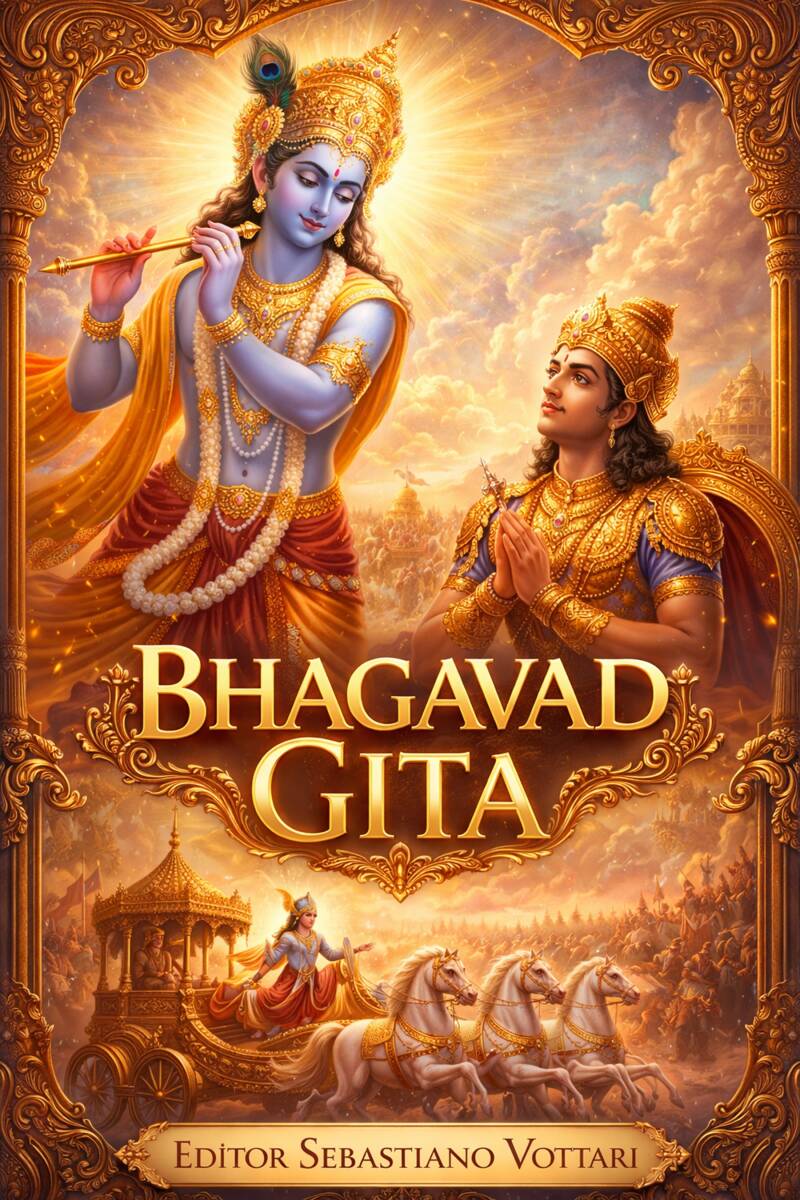
The Bhagavad Gita—the "Song of the Lord"—is one of the most profound, universal, and influential texts ever written by humanity. Composed over two thousand years ago and nestled at the heart of the Mahabharata, the greatest epic in world literature, it presents itself as a dialogue between the warrior prince Arjuna and his divine charioteer Krishna on the battlefield of Kurukshetra , in the suspended moment preceding a fratricidal war.
But the Gita is much more than a battlefield dialogue. It is a dizzying compendium of all Indian philosophy: a treatise encompassing metaphysics and ethics, psychology and mysticism, cosmology and theology, of a breathtaking density and beauty. In eighteen chapters, Krishna guides Arjuna—and with him every reader—through an inner journey that begins in the darkest despair and reaches the luminosity of supreme knowledge.
Why this edition?
Complete Translation - All 18 chapters, without omissions, without summaries, without abbreviations. From the first line of the first chapter to the last line of the eighteenth. Nothing has been left out.
Original Translation - Not a copy or adaptation of existing translations, but a new and original rendering based directly on the traditional Sanskrit text. A fresh take on a thousand-year-old text.
Free from interpretative bias - This translation does not serve any philosophical school, religious tradition, or sectarian orientation. It does not favor Shankara's Advaita, Ramanuja's Vishishtadvaita , or the devotional vision of any particular movement. It allows the text to speak, with minimal interference.
Clear and Solemn Language - A linguistic register that combines noble expression with natural flow. Accessible to the contemporary reader without trivializing the profound message. Solemn without being artificial.
Clear Structure - Each chapter is presented with a title and precise verse numbering. Ideal for both continuous reading and for consulting and meditating on individual passages.
In-Depth Preface - An extensive introduction that guides the reader in understanding the historical, philosophical and spiritual context of the work, illustrating the great paths of Yoga set forth in the Gita: Karma Yoga, Jnana Yoga, Bhakti Yoga and Dhyana Yoga.
The 18 Chapters
- Arjuna's Yoga of Despondency
- The Yoga of Knowledge
- The Yoga of Action
- The Yoga of Renunciation of Action through Knowledge
- The Yoga of Renunciation of Action
- The Yoga of Meditation
- The Yoga of Knowledge and Wisdom
- The Yoga of the Imperishable Brahman
- The Yoga of the Royal Science and the Royal Secret
- The Yoga of Divine Manifestations
- The Yoga of the Vision of Universal Form
- The Yoga of Devotion
- The Yoga of Distinction between the Field and the Knower of the Field
- The Yoga of Distinction between the Three Qualities
- The Yoga of the Supreme Spirit
- The Yoga of Distinction between Divine Nature and Demonic Nature
- The Yoga of Distinction between the Three Forms of Faith
- The Yoga of Liberation through Renunciation
Who is it for?
This edition is intended for everyone: for those approaching Indian philosophy for the first time, for yoga practitioners wishing to rediscover the spiritual roots of their discipline, for spiritual seekers exploring humanity's great wisdom traditions, for students of philosophy and comparative religion, and for any reader seeking nourishment for the soul and the intellect.
The Bhagavad Gita has inspired millions of human beings for centuries—kings and beggars, philosophers and poets, scientists and contemplatives. It accompanied Gandhi in his struggle for freedom, and fascinated Emerson, Thoreau, Einstein, and Hesse. It is a text that speaks to everyone because it addresses what is universal in humanity: the conflict between duty and affection, between action and contemplation, between the desire for happiness and the reality of suffering, between the finiteness of existence and the intuition of the Infinite.
It's not a text to be read just once. It's a traveling companion that reveals new meanings with each reading, at every stage of life.