Gautama Siddartha Buddha in English
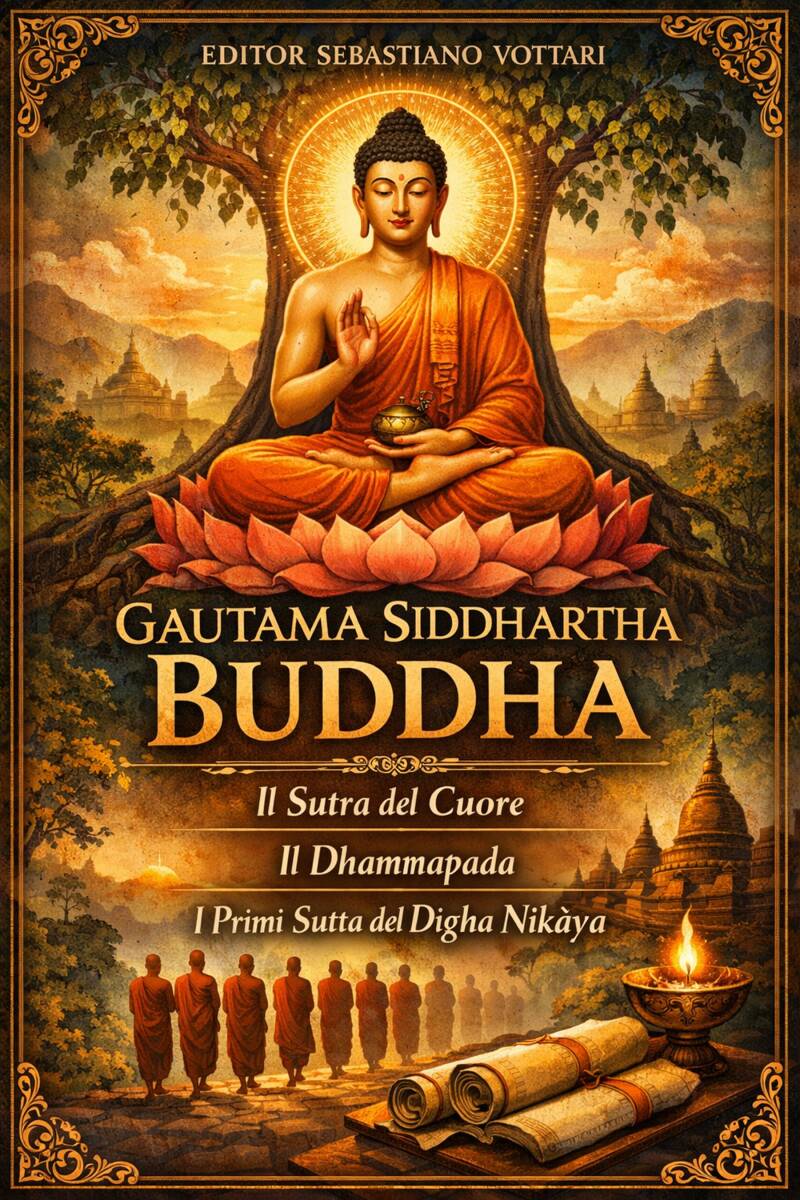
Gautama Siddartha Buddha in English
Three pillars of Buddhist thought, brought together in a single volume for the first time.
The Heart Sutra —the most recited sacred text of Mahayana Buddhism , in its full translation. In a few dazzling lines, the bodhisattva Avalokiteshvara reveals to Sariputra the empty nature of all phenomena. A distillation of wisdom that has accompanied the meditation of millions of practitioners for over a millennium.
The Dhammapada —all 423 verses, divided into the traditional 26 chapters. It is the most beloved and cited book of the Pali canon : a collection of the Buddha's direct teachings on the mind, discipline, vigilance, wisdom, and the path to liberation. Each verse is a standalone gem; together, they form a comprehensive guide to the inner life.
The first nine suttas of the Dīgha Nikāya — the Buddha's great "Long Discourses," presented in full and unpublished translation, each accompanied by an extensive final note of commentary and contextualization:
DN 1 – Brahmajāla Sutta (The Net of Brahma): the monumental classification of 62 erroneous philosophical views, and the method by which the Buddha dismantles them one by one.
DN 2 – Sāmaññaphala Sutta (The Fruits of the Contemplative Life): King Ajātasattu , tormented by remorse, asks the Buddha what concrete benefits the monastic life brings. The answer is the complete gradual path, from virtue to jhāna to liberation.
DN 3 – Ambaṭṭha Sutta : A confrontation with an arrogant young Brahmin about true nobility — not of blood, but of conduct and knowledge.
DN 4 – Soṇadaṇḍa Sutta : What truly makes a Brahmin a Brahmin? The Buddha leads an elderly master to shed his certainties, one at a time.
DN 5 – Kūṭadanta Sutta : The perfect sacrifice requires no blood. The Buddha tells of an ancient king who transformed the ritual into social justice.
DN 6 – Mahāli Sutta : Divine visions and superhuman perceptions — the Buddha explains why they are not the goal of practice.
DN 7 – Jāliya Sutta : Is the soul identical with the body, or distinct from it? The Buddha rejects both positions.
DN 8 – Mahāsīhanāda Sutta (The Great Lion's Roar): A close examination of extreme ascetic practices and what truly leads to purification.
DN 9 – Poṭṭhapāda Sutta : The nature of perception, the status of the self, and the relationship between language and reality — one of the philosophical peaks of the canon.
A work for those who want to go to the source. Not a summary, not an introductory manual: the Buddha's texts themselves, translated in their entirety with meticulous philological care and accompanied by notes that illuminate their historical, doctrinal, and narrative context.
Whether you are a practitioner, a scholar, or simply a curious reader, this volume offers you direct and comprehensive access to words that have continued to transform those who listen for twenty-five centuries.